

A dog with car anxiety may pant, shake or plant her feet at the car door, often before the engine even starts. This guide from WakaPaw helps you find the cause, read her stress signs, follow a step-by-step plan for calmer rides and know when to call your vet.
Key Takeaways
- If she drools or throws up on the road: that points to car sickness. Treat the car sickness first with your vet, then work on the fear.
- If an older dog suddenly won't jump in: she may be hurting. Ask your vet to check her joints, back and eyes before you start fear training.
- If she's scared of the car itself: pair the car with treats, meals and play in small stages. Stop before she gets scared, and take a step back after a bad session.
- If she won't get in at all: reward each step she chooses to take toward the car, and never pull her in.
- If she panics or progress stalls: pause and ask your vet or a board-certified vet behavior expert for help.
- Want a non-slip spot she knows on every ride? our Back Seat Cover for Dogs is our top pick. It gives her steady footing and a view of you on every ride, though it isn't a calming product.
Why Some Dogs Get Car Anxiety
Dogs learn by linking things together, and that is often where car fear starts. If the car always means the vet, the groomer or a boarding kennel, your dog soon connects the two. AKC points to trips that mostly end somewhere unpleasant. Fear Free notes that for many dogs, the stress of a vet visit starts with the car ride. Other common causes include these.
- A bad first ride: an upset stomach, a sudden stop or a loud noise you never noticed can be enough.
- The car itself: engine noise, motion, things rushing past the windows and being shut in a small space.
- Bad footing: Bond Vet says shaky footing scares some dogs. A dog sliding on a leather seat at every turn has a real reason to tense up.
- Too few happy rides: a dog who almost never rides has no good trips to outweigh one scary one.
Dog Car Anxiety Signs, From Mild to Severe

Fear tends to build in stages, and the early signs are quiet. Trainers at Preventive Vet name a few small stress signs: yawning, lip licking, sniffing the ground and sudden scratching. Catch your dog at that stage, and you can stop before she panics.
| Level (a rough guide) | What you see | What to do |
|---|---|---|
| Mild | Yawning, lip licking, sniffing or scratching, looking away from the car | Make it easier: stand farther back or keep it shorter |
| Rising | Panting, pacing, won't settle, ignores treats | Stop the session. Go back one step next time |
| High | Shaking, whining, barking, ears pinned back, wide eyes, planting her feet at the door | End it calmly and give her space |
| Panic | Trying to escape, jumping at windows | Stop practice and ask your vet for help |
Watch whether she eats: AKC notes that a nervous dog often won't eat or play. If she takes treats on the driveway but spits them out on the back seat, the seat is still too much for now. Practice where she still eats, and move closer later.
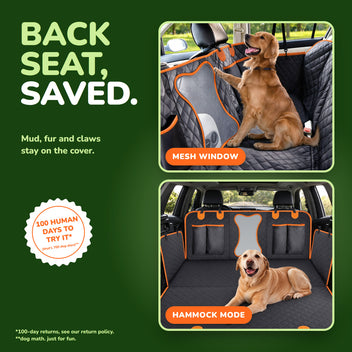
Waterproof dog seat cover for the back seat: mud, fur and drool stay off, and your dog sees you through the...
How to Ease Dog Car Anxiety in 4 Steps
Easing car anxiety works best in a set order. First check for sickness and pain, then set up her spot. After that, go to Step 3 if she won't get in, or straight to Step 4 if she will.
Step 1: Rule out car sickness and pain

Start here, because sickness, pain and fear each need a different fix. Writing for Fear Free Happy Homes, vet Dr. Kathryn Primm says some dogs are truly sick in the car. Others show the same signs because they're stressed. Her advice: treat the car sickness first, then work on the fear.
- Fear usually starts early: at the leash, the keys or the open car door, before the engine is on.
- Car sickness usually builds on the road: drooling and throwing up once the car is moving.
- Often it's both: a puppy who felt sick on every ride learns to dread the car.
See your vet first if the fear is new, strong or getting worse, or if you're not sure which one you're seeing. Your vet can check for car sickness and talk about anti-nausea medicine. Your vet can also plan medicine for trips you can't skip while you train.
Older dogs: an older dog who used to jump in and suddenly won't may be hurting. Ask your vet to check her joints, back and eyes before you start fear training. A non-slip surface on the seat helps her stay steady once she's up. After the ride, watch for limping or stiffness, and tell your vet.
Step 2: Give her the same spot every ride

The same spot every ride tells her what to expect. Set it up once, then keep it the same:
- Pick a crate or a car harness for her to ride in.
- Let her get used to it at home first, so it isn't one more new thing in the car.
- Use the same place on the back seat every time.
Our seat cover, shown further down, can make that spot steady underfoot.
Step 3: If she won't get in, let her choose

If your dog won't get in the car, don't pull her in. Preventive Vet's plan for adult dogs rewards each step she chooses to take toward the car. There's no luring with food, and no pulling on the leash.
- Stand where she's still relaxed, even if that's across the driveway.
- Praise and reward each look at the car, then each step toward it.
- Make the step easy: a ramp or a low step helps a small or stiff dog.
- Reward her choice: when she puts her front paws in on her own, toss her a treat. Never use food to pull her past the point where she feels safe.
Expect slow days at the car door, and keep rewarding each step she takes on her own. Once she gets in by herself, move on to Step 4.
Step 4: Follow a 7-stage plan to make rides calmer

The plan pairs the car with things your dog loves. You show her the car in small, easy pieces, and each piece comes with food or play. Vets call this desensitization and counterconditioning. Behavior experts at VCA Animal Hospitals say it works best when she stays relaxed the whole time.
| Stage | What you do | Move on when |
|---|---|---|
| 1 | Play or toss treats near the parked car | She walks up to the car on her own |
| 2 | Treats on the back seat, doors open, engine off | She hops in, eats and hops out easily |
| 3 | A full meal in her spot, doors open | She eats with a loose, relaxed body |
| 4 | Doors closed, you in the driver's seat | She stays settled for a few minutes |
| 5 | Engine on for 1 to 2 minutes, then off | She keeps eating, and her body stays loose |
| 6 | Drive to the end of the street and back | No panting, pacing or whining |
| 7 | Short drives to a park, a friend or a favorite walk | She looks happy to see the car |
Session rules: start with a few minutes at a time, and stop before she gets uneasy. VCA's experts suggest practicing at least twice a week, daily if you can. Move up only after 2 or 3 calm sessions in a row.
Stay safe while you practice: keep her on a leash any time the doors are open. Once the car moves, she rides buckled in or crated.
If she struggles, go back a step. VCA warns that pushing on while she's scared can make the fear stronger next time. Some dogs get through the stages in days, and others need months. Best Friends Animal Society keeps the first real drive to 5 minutes, then dinner in the driveway.
A step back isn't a failure. Every calm session, however short, teaches her that the car can be a good place.
Mistakes That Make Car Anxiety Worse
Most of these mistakes come from trying to help. Whole Dog Journal lists several of them. Check this table as you work through the steps.
| What happens | What to try |
|---|---|
| She feels sick on the road after lots of treats right before a drive | A full stomach can make a nervous dog feel sick. Save big meals for parked-car practice |
| Every ride ends at the vet | Add more rides that end somewhere fun, like the park |
| She roams the car, runs from window to window and gets herself worked up | Buckle her in or crate her instead |
| You try to train her while you drive | Practice while parked, because you can't watch her and the road at the same time |
| The car is too hot or too cold | Practice in a car that's already a comfy temperature. Never leave her alone in it |
Calming Aids, Vet Medicine and When to Get Help

Calming sprays and collars: these use a calming scent made to copy a mother dog's (a pheromone). A 2021 review in Veterinary Evidence found only weak proof that it helps anxious dogs. It's unlikely to harm, and it can be one part of a plan. But it shouldn't replace training.
Comfort you already own: bring a washable shirt that smells like you, and offer a long-lasting chew during parked-car practice. Soft music can help too. So can a towel over a crate, as long as air still gets in.
Medicine: only your vet can decide if anti-anxiety or anti-nausea medicine suits your dog. Bond Vet suggests a test run at home before the trip, so you know how she reacts. Timing is different for each medicine. Ask your vet well ahead when and how to give it.
Important: if progress stalls, she panics, or she growls or snaps, VCA says to pause. Don't push her through the next stage. Ask your vet or a board-certified vet behavior expert for help instead. Medicine can ease her fear enough for the training to work.
Our Back Seat Cover for Dogs: A Steady Spot to Practice In

No seat cover can cure fear, and ours isn't a calming product. What it does give her is a steady place she knows, ride after ride. Here's how it fits the setup from Step 2.
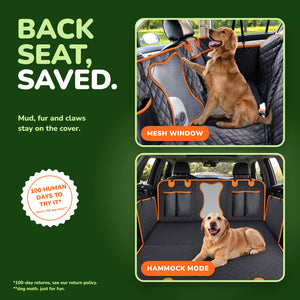
- Footing: quilted fabric, a grippy backing and seat anchors, so she's less likely to slide at every turn.
- No gap to slip into: in hammock mode it closes off the floor gap behind the front seats.
- A view of you: the mesh window between the front seats lets her see you from the back seat.
- Easy to clean: nervous dogs drool and pant. The waterproof top wipes clean, and the cover goes in the washing machine.
Important: the pet seat belt in the box is a basic tether. It is not crash-certified, so don't count on it in a crash. For crash safety, use a crate or harness certified by the Center for Pet Safety.
Size, setups and what comes with it
For $89.99, you get the cover, fit help before you buy and 100 days to change your mind. Set up her spot once, and keep practicing.
Size: 53 in at the seat, with door flaps where claws scrape on the way in. Not sure it fits? Send your car's make and model before you buy, and we'll check the fit for you.
Three setups: hammock, bench cover or cargo liner, so her spot can move with her.
In the box: the cover, headrest straps, seat anchors and a basic pet seat belt tether (not crash-certified).
Free worldwide shipping and 100-day returns: email us within 100 days of delivery. A real reply comes within 24 hours, every day of the week.
Sold only on our site: to compare other brands, read our best dog car seat covers guide.
Get the Back Seat Cover for Dogs: free worldwide shipping, 100-day returns
Conclusion: Small Steps, Calmer Rides
To ease car anxiety, check for car sickness and pain first. Then let your dog learn at her own pace that the car means treats, meals and fun places. Once short drives feel easy, our road trip with a dog guide helps you plan the longer ones, so she can come along on more of your trips.
If you're looking for a steady, familiar spot for her to practice in, the Back Seat Cover for Dogs is a great choice. It gives her the same grippy, washable place on every ride, with a mesh window to see you. It's $89.99, with free worldwide shipping and 100-day returns.
Have questions about the cover or how it fits your car? Contact us at support@wakapaw.com. Our team responds within 24 hours, 7 days a week. For health worries, call your vet first.
FAQs
How do I calm my dog's car anxiety?
Break car rides into small steps, starting with the parked car. Pair each step with treats, a meal or play. Keep sessions short and stop before she gets scared. Ask your vet if progress stalls.
Why is my dog afraid of car rides?
Often the car has come to mean the vet, the groomer or a boarding kennel. A bad first ride, engine noise and motion, or sliding on the seat can also start the fear. A dog who rarely rides has no happy trips to outweigh a scary one.
How long does it take to ease dog car anxiety?
It depends on the dog. Dogs who have been scared for a long time can take months. Let her calm body, not the calendar, decide when to move on.
Why does my dog shake in the car?
Usually fear, sometimes car sickness, and now and then pain or cold. If the shaking starts before the car moves, fear is more likely. If it comes with drooling and throwing up on the road, ask your vet about car sickness.
Should I give my dog medicine for car anxiety?
Only medicine your vet prescribes. Your vet can pick a calming or anti-nausea option, set the dose and suggest a test run at home. Never give human pills on your own.
Does a seat cover help with dog anxiety in the car?
It doesn't treat fear, but it can help with the setup. She gets the same non-slip spot every ride and can see you through the mesh window. The training does the real work.
What if my dog won't get in the car?
Don't force her in. Reward every step she chooses to take toward the open door. Make the step up easier with a ramp. And check with your vet that pain isn't the reason.
