

To get cat pee out of carpet, blot fresh urine, rinse carefully if the material permits, and treat remaining residue with a compatible cleaner. This guide from WakaPaw explains fresh-accident cleanup, hidden spots, older odors, and affected padding. Lasting results depend on reaching the source rather than repeatedly freshening the surface.
- Blot immediately: absorb fresh urine without rubbing it into the carpet.
- Check compatibility first: carpet fibers, dyes, backing, and padding affect the treatment.
- Follow the cleaner’s method: some products require deeper wetting; WakaPaw specifies misting and drying.
- Inspect recurring odors: contamination may extend beyond the visible mark.
- Prevent new accidents: cleanup should accompany litter-box care and attention to your cat’s health.
Why Cat Urine Smell Lingers in Carpet

Cat urine can travel through the carpet pile into the backing and padding. A patch may feel dry while residue remains in layers you cannot reach with a quick wipe.
The odor can also change as urine compounds break down. RIKEN researchers identified breakdown products of felinine that contribute to the characteristic smell of cat urine. Covering that smell with fragrance does not remove the contamination.
A remaining mark needs separate consideration. The Carpet and Rug Institute explains that urine can affect carpet dyes, so some discoloration may be permanent even after cleaning. More product will not necessarily reverse a permanent color change.
What You Need to Get Cat Pee Out of Carpet

Prepare your supplies before wetting the area. Read the carpet-care instructions and the selected cleaner’s directions so you know how to apply, finish, and dry the treatment.
You may need:
- Gloves.
- Clean white towels or plain white paper towels.
- Cool water, if the carpet permits wet cleaning.
- A carpet-compatible urine treatment.
- A fan or suitable ventilation.
- An optional purpose-made UV urine-detection light.
- Approved extraction equipment for a larger cleanup, where appropriate.
Spot-test products as directed. For wool, delicate fibers, or blended materials, choose a method suitable for the most sensitive component. WoolSafe advises particular care with moisture-sensitive fibers and mixed-fiber rugs.
How to Get Cat Pee Out of Carpet: Step by Step for Fresh Stains

Fresh accidents give you an opportunity to remove liquid before it spreads farther. Start with absorption, then use a cleaning method matched to the carpet.
Step 1 – Blot, Don’t Rub

Press a clean absorbent towel onto the wet patch. Replace it as it becomes damp, continuing until little more urine transfers.
Avoid scrubbing or working the liquid outward. Keep shoes and other fabrics away from the affected area so you do not carry residue elsewhere.
Blotting rather than scrubbing helps avoid spreading contamination and disturbing carpet fibers.
Step 2 – Rinse With Cool Water

If the material permits water-based cleaning, use a controlled amount of cool water to help lift accessible urine. Blot again with fresh towels.
Do not pour water until the backing is soaked. For a large accident, approved extraction equipment may be more practical than repeatedly adding water and trying to absorb it by hand.
Humane World for Animals includes a cool-water rinse and blotting in its guidance for fresh urine accidents. Follow the carpet’s moisture restrictions throughout.
Step 3 – Apply an Enzyme Treatment According to Its Directions

Choose a product approved for the affected carpet. Confirm whether its method calls for misting, spraying, or a wetter treatment rather than assuming every enzyme cleaner needs saturation.
For compatible fabric odor care after initial cleanup, WakaPaw applies its enzyme formula as a fine mist. Do not substitute another product’s soaking instructions for its published method.
If urine has reached deeper layers, assess those layers before relying on a surface treatment. Applying more liquid without a suitable plan can leave the carpet unnecessarily wet.
Step 4 – Allow Contact Time and Follow the Finishing Instructions

Some cleaners require blotting or residue removal after a stated period. Others remain in place until dry. Follow the instructions for the bottle you are using.
WakaPaw’s published method is to let the mist dry rather than blotting it away immediately. Keep cats away until the treated surface is completely dry.
Avoid adding another cleaner while the first treatment is still underway. A stronger mixture is not a substitute for completing the correct process.
Step 5 – Air-Dry Fully and Vacuum

Keep the area open to airflow and avoid placing furniture or an impermeable cover over damp carpet. Use ventilation or a fan where appropriate.
Once the carpet is fully dry, vacuum if the material-care and product instructions permit it. Recheck the area for odor, staining, or remaining moisture.
If the smell returns, investigate the affected area and depth before repeating the same application. Surface appearance alone does not establish that every contaminated layer is clean.
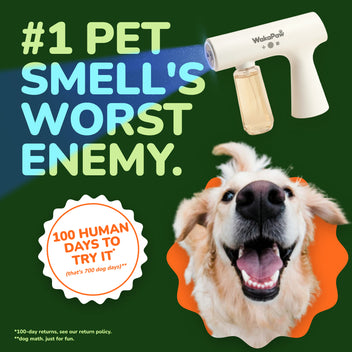
Eliminate stubborn pet odors with WakaPaw Pet Odor Eliminator Spray. Enzyme-powered formula helps tackle od...
How to Find Hidden Cat Urine in Carpet

Inspect corners, carpet edges, baseboards, and areas beside or beneath furniture. Follow the strongest odor and look beyond an obvious mark, since urine can spread underneath.
A purpose-made UV urine-detection light may help identify suspected deposits in a darkened room. Fluorescence is a clue rather than proof: other residues can glow, and some urine spots may be difficult to see.
Use visual inspection and odor together. Humane World for Animals recommends these approaches, including blacklight inspection, when looking for older soiling. Do not assume a device’s visible blue light has the same urine-detection function.
How to Get Old Cat Urine Smell Out of Carpet

Older deposits may involve dried residue, overlapping accidents, and previous cleaning products. Identify what has already been applied before choosing the next treatment.
Some urine products specify controlled rewetting and longer contact for older contamination. Follow those particular directions and the carpet’s care limits; do not assume every old spot needs an overnight soak.
Persistent discoloration and persistent odor may have different causes. If the smell repeatedly returns, arrange a deeper assessment rather than continually increasing the concentration or amount of surface cleaner.
Using WakaPaw After Dried-Urine Cleanup: Blot, Mist, Let Dry

After removing accessible contamination, a cat urine remover enzyme treatment from WakaPaw can fit into odor care on compatible fabrics.
Use it as directed:
- Check compatibility and spot-test.
- Insert the WakaPaw enzyme bottle.
- Mist from about 2 feet away, sweeping slowly.
- Let the surface dry fully before cats return.
The cordless device uses a fragrance-free, plant-based formula. The Starter Kit is currently $99.99 with a free enzyme bottle, with 100-day returns subject to the policy. Check the product page for current offers.
Home Remedies for Cat Pee on Carpet: Vinegar, Baking Soda and Hydrogen Peroxide

Household ingredients have limited, material-dependent uses. They should not become an improvised combination applied over an enzyme treatment.
- Vinegar: diluted white vinegar appears in some carpet-care guidance, but it is not suitable for every material or a dependable solution for deep deposits. Use it only when the carpet manufacturer permits it.
- Baking soda: it may freshen a dry, cleaned area when both the carpet and vacuum manufacturers allow fine powders. It does not extract urine from padding.
- Hydrogen peroxide: it can affect carpet dyes. Even a 3% solution requires an explicitly approved method and a hidden-area test.
Never mix vinegar with peroxide or bleach, and do not add household ingredients to a formulated cleaner without manufacturer approval.
Do Home Remedies Work as Well as an Enzyme Cleaner?
There is no universal answer for every carpet and accident. A purpose-formulated enzyme treatment offers directions for a defined use, while household remedies have narrower applications.
| Option | Useful role | Main limitation |
|---|---|---|
| Cool water and blotting | Removing accessible fresh urine | Can leave absorbed residue |
| Diluted vinegar | Selected carpet-care tasks | Not universally compatible |
| Baking soda | Optional dry-area freshening | Does not remove deep contamination |
| Approved peroxide treatment | Treatment of certain discoloration | Can affect dyes |
| Enzyme treatment | Addressing suitable organic residue | Must suit the material and contact the residue |
Vinegar and plain peroxide are not equivalent to purpose-formulated pet-cleaning products. Choose a compatible process rather than assuming a household mixture will reproduce a cleaner’s performance.
How to Clean Cat Urine From a Rug

Check the rug’s care label and inspect the underside. Urine may have reached the rug pad or the flooring beneath it.
| Rug type | Recommended starting point | Main precaution |
|---|---|---|
| Machine-washable | Remove the initial mess and follow the washing instructions | The rug cover and pad may need different care |
| Wool | Blot and choose a wool-approved method | Do not assume every enzyme formula is suitable |
| Jute, sisal, seagrass, or coir | Absorb liquid and seek material-specific advice | Excess moisture can affect color and texture |
| Viscose or delicate blends | Follow guidance for the most sensitive fiber | Avoid unapproved wetting or scrubbing |
| Valuable or unidentified rug | Consult a qualified rug cleaner | Fiber, dyes, and construction may be uncertain |
WoolSafe recommends treating blended rugs according to their most sensitive component. Keep an affected rug from transferring moisture to the floor while following an appropriate cleaning plan.
When Cat Urine Soaks Into the Carpet Padding

Padding can hold contamination that remains after the pile has been cleaned. Repeated accidents in the same location increase the need to investigate below the surface.
Consider a professional assessment when:
- Odor returns after the carpet dries.
- Several accidents overlap.
- The affected area is large.
- Previous surface treatments have repeatedly failed.
- There is evidence of contamination near seams or beneath the carpet.
A qualified cleaner can assess treatment, extraction, and any need to replace affected materials. Humane World for Animals notes that contaminated padding may require replacement; surface odor care can support maintenance after the deeper source has been addressed.
Why Cats Pee on the Same Carpet Spot—and How to Stop It

Residual odor may contribute to repeat use, but it is not the only explanation. Litter-box difficulties, stress, marking, and medical problems can also be involved.
Clean affected materials, keep cats away during treatment, and review litter-box access and cleanliness. Arrange a veterinary assessment for new or recurring accidents rather than assuming your cat is being spiteful. Cornell identifies medical problems, box aversion, and surface preferences among possible causes.
Seek immediate veterinary care if your cat repeatedly strains while passing little or no urine. A urinary blockage is an emergency and should not wait for cleanup or litter-box changes.
Conclusion

To get cat pee smell out of carpet, absorb fresh urine, use a compatible treatment, and allow full drying. For older accidents, locate the full affected area and investigate padding when the smell returns.
For compatible fabric odor care after initial cleanup, WakaPaw Pet Odor Eliminator offers a convenient misting option. Lasting improvement also depends on preventing new accidents and addressing their underlying cause.
Have a product question? Email support@wakapaw.com, and follow WakaPaw on Facebook and Instagram for pet-home care tips and product updates.
FAQs
What is the fastest way to get cat pee out of carpet?
Blot fresh urine promptly, rinse carefully if the carpet permits it, and follow a compatible treatment’s directions. Removing accessible liquid early helps, but the full cleaning and drying process still matters.
Can old cat urine smell be removed from carpet?
It may improve with appropriate treatment, but results depend on the material and depth of contamination. Padding or underlying flooring may require additional attention.
Can I use WakaPaw on a carpet urine spot?
Yes, on compatible carpet after initial cleanup. Spot-test, follow the misting instructions, and allow full drying before cats return.
Should I saturate the carpet with WakaPaw?
Its published method calls for misting from about 2 feet away. Do not replace that method with another cleaner’s saturation instructions.
Does baking soda remove cat urine from carpet?
It may freshen a dry, cleaned area, but it does not extract urine or establish that contamination beneath the surface is gone.
Why does cat urine smell return after cleaning?
Part of the deposit may remain, deeper layers may be affected, or a new accident may have occurred. Reassess the source before repeating surface treatment.
Can I steam-clean cat urine?
Avoid using steam as an improvised treatment for untreated urine deposits. Follow material-specific guidance and distinguish steam equipment from approved liquid-extraction methods.
Does a remaining yellow stain mean the carpet is still dirty?
Not necessarily. Urine can alter carpet dyes, leaving permanent discoloration. Assess odor and contamination separately from the visible mark.
